During National Disability Employment Awareness Month (NDEAM), we highlight the valuable contributions of workers with disabilities and the importance of inclusive employment. Although NDEAM 2025 has ended, advocating for inclusion and meaningful employment for people with disabilities remains essential.
For Parker Crim, a 19-year-old man with Down syndrome who lives in Fort Worth, volunteering with local nonprofits has helped him develop job skills and gain work experience — all while he completes a transition program for young adults with disabilities who have finished high school and are entering adult life.
While everyone’s experience is unique, Parker’s story demonstrates how opportunities for people with disabilities, through volunteering and skill-building, can create pathways to jobs that are personally and financially fulfilling.
In many ways, Parker Crim is a typical 19-year-old. He enjoys spending time with family and friends. He has hobbies and passions. He likes to tell jokes. He loves professional wrestling.
But as he enters adulthood, Parker faces a situation common for many young adults with developmental disabilities (DD). After graduating from high school and letting go of the structure of school life, young adults with DD often encounter barriers to important services and support, a lack of social activities, and difficulty finding employment.
For Parker, a tremendous network of supportive friends and family has helped him navigate his transition into adult life, said Andy Crim, Parker’s father and chair of the Texas Council for Developmental Disabilities. Parker’s network includes Michelle Crim, who is Andy’s wife and Parker’s bonus mom.
Seeking ways to help their son stay engaged, meet new people, and develop job skills, Andy and Michelle asked Parker if he’d be interested in volunteering with a local nonprofit.
“I looked at volunteerism as an opportunity [for Parker] to be around people he’s not normally around and to develop skills that he can put on a resume,” Andy said.
Michelle has a professional background as a nonprofit consultant and grant writer as well as connections with nonprofits in the Fort Worth area. She knew just how many organizations rely on volunteers to fulfill their missions.
“I think volunteer opportunities are amazing in the nonprofit sector,” Michelle said. “Nonprofits definitely need people of all different abilities to help and volunteer.”
Finding opportunities
With Parker’s enthusiasm for the idea, the family turned to social media to see if anyone knew of volunteer opportunities that would be a good fit. Parker works best when shown positive reinforcement and patience. He thrives in places where he can have new experiences, make friends, and learn new skills while figuring things out in his own way.

“He’s a very empathetic person,” Michelle said. “He’s very good at knowing when someone needs a smile, a hug, a high-five. He’s really, really good about being that kind of uplifting personality.”
The first opportunity came from Ronald McDonald House Fort Worth, which supports families with children receiving urgent medical care at local hospitals. Parker’s older brother, Matt, previously volunteered with the organization.
Parker does a variety of tasks at Ronald McDonald House. He shared how he puts together baskets of toiletries and hygiene products for families. While the work can be hard, Parker said his favorite part is being able to help people. The work also carries special meaning.
As a child, Parker received care at Cook Children’s Medical Center. Many families helped by Parker and other volunteers stay at the same hospital.
Along with Ronald McDonald House, Parker recently started another volunteer opportunity at Tech Fort Worth (TechFW), a nonprofit incubator and accelerator for technology startup companies.
TechFW gives Parker a chance to practice a different set of workplace skills and see what’s involved in running an office. He sorts and delivers mail, helps set up events, keeps copiers stocked with paper, and completes other tasks.
Andy said he hopes more organizations recognize the value that people with DD can offer to organizations in need of volunteers.
“I wish more organizations would consider people with intellectual and developmental disabilities as worthy volunteers and commit to opening places for them,” he said.
Nonprofit perspective
Blake Aldridge, operations manager at TechFW, said bringing on Parker as a volunteer has given Aldridge and his colleagues a new perspective on how to provide the right support for people who have different ways of learning new things. For Parker, that’s meant having daily check-ins and creating flow charts, complete with photos of Parker performing tasks, to help him visualize and master his responsibilities.
Working with Parker has also been transformative for the TechFW team, said Caitlin McMinn, the organization’s executive director.
“We realized we could do this again,” she said. “We’re putting together a folder of resources and guides so we can continue to help our community in any way they need.”
Aldridge said he hopes Parker gains a sense of independence, belonging, and confidence through his time at TechFW. He added that the benefits go both ways.
“It’s challenged us to meet people where they’re at, to work with people who are different from us, and to notice the little things,” Aldridge said. “I hope he leaves every day proud of the work he accomplished.”
Tonja Sparks, volunteer services manager at Ronald McDonald House Fort Worth, said creating an inclusive volunteer program requires intention and heart. Starting small and partnering with schools or organizations that support people with disabilities is a good place to begin.
Parker and other volunteers at Ronald McDonald House learn a wide range of job and life skills, including time management, team communication, task organization, customer service, and more. The key is creating a space where everyone feels valued and capable, Sparks said.
“Including people with intellectual and developmental disabilities isn’t just about offering opportunities; it’s about recognizing ability, purpose, and potential in every person,” she said.
‘No fear, no shame, no hesitation’
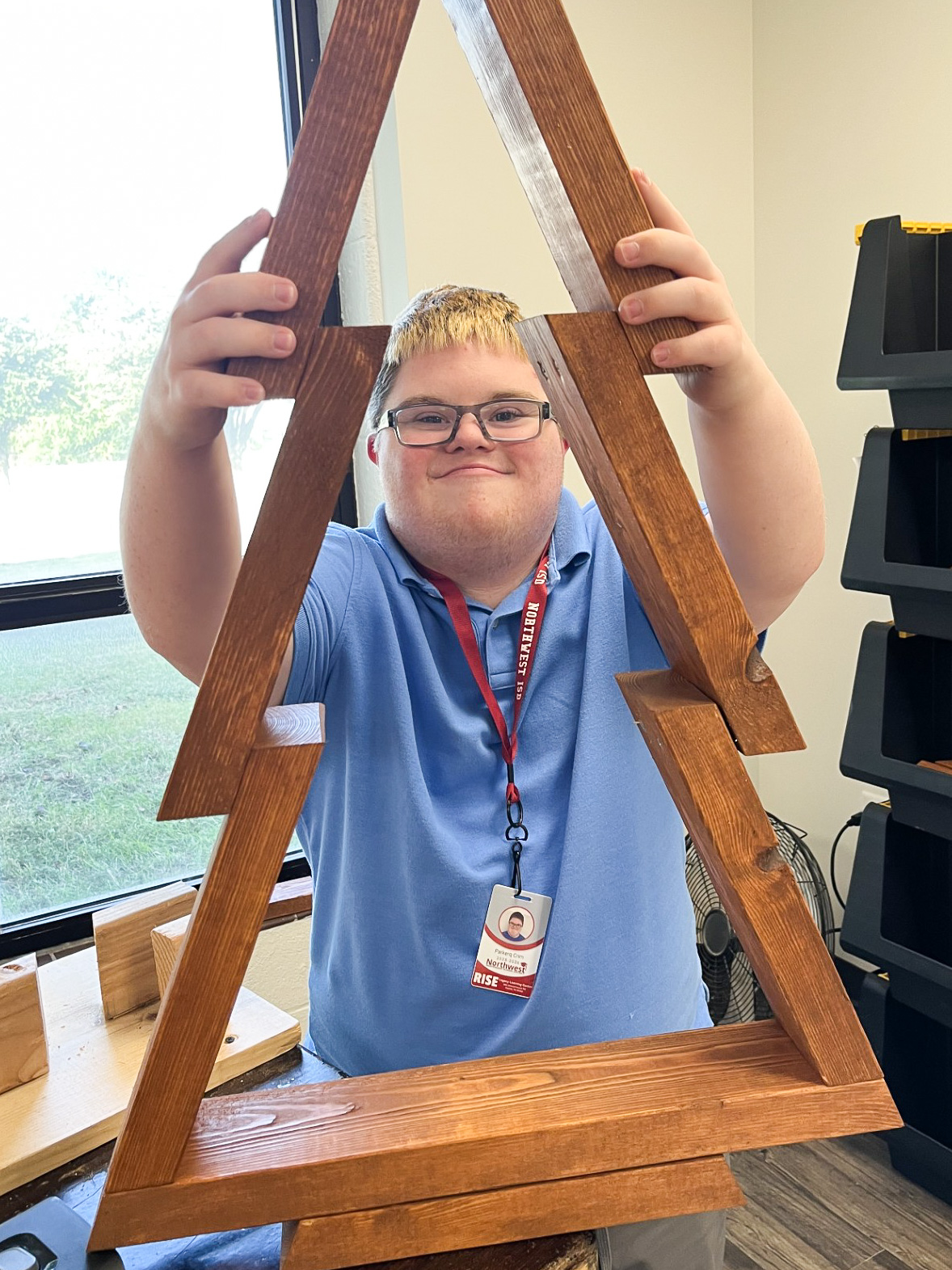
In addition to volunteering, Parker participates in a transition program called RISE (Reaching Independence through Supported Education). Run by Northwest ISD, the RISE program supports students with disabilities between 18-21 years old who have finished high school but are still completing their individualized education programs.
Through RISE, Parker learns new skills in the areas of employment, independent living, and recreation. He works in both a print shop and a wood shop. Recently, he made a wooden Christmas tree that he plans to sell at an upcoming craft fair. Once a week, Parker joins his fellow students on a group shopping trip to buy groceries, which they use to prepare meals together.
Parker’s future goals include running a specialty ketchup and barbecue sauce company, called Parker Jack Gourmet, with his dad. Parker said his dream job is to be a chef in a restaurant, listing enchiladas and brownies as some of his specialties.
Michelle said it’s important for families to embrace their children’s talents. She hopes that Parker’s story shows that volunteering can be an effective way for people with DD to gain valuable work experience.
For Andy, seeing Parker build a network of friends and supporters while he moves through life in his own way is a source of pride and inspiration.
“We’ve just worked to enable and empower Parker. I know those sound like buzzwords, but that’s really what we do,” Andy said. “He has traits and qualities I wish I had an inkling of. He has no fear, no shame, no hesitation. He just goes, and it’s amazing to see.”
During National Disability Employment Awareness Month (NDEAM), we highlight the valuable contributions of workers with disabilities and the importance of inclusive employment. Although NDEAM 2025 has ended, advocating for inclusion and meaningful employment for people with disabilities remains essential.
For Parker Crim, a 19-year-old man with Down syndrome who lives in Fort Worth, volunteering with local nonprofits has helped him develop job skills and gain work experience — all while he completes a transition program for young adults with disabilities who have finished high school and are entering adult life.
While everyone’s experience is unique, Parker’s story demonstrates how opportunities for people with disabilities, through volunteering and skill-building, can create pathways to jobs that are personally and financially fulfilling.
In many ways, Parker Crim is a typical 19-year-old. He enjoys spending time with family and friends. He has hobbies and passions. He likes to tell jokes. He loves professional wrestling.
But as he enters adulthood, Parker faces a situation common for many young adults with developmental disabilities (DD). After graduating from high school and letting go of the structure of school life, young adults with DD often encounter barriers to important services and support, a lack of social activities, and difficulty finding employment.
For Parker, a tremendous network of supportive friends and family has helped him navigate his transition into adult life, said Andy Crim, Parker’s father and chair of the Texas Council for Developmental Disabilities. Parker’s network includes Michelle Crim, who is Andy’s wife and Parker’s bonus mom.
Seeking ways to help their son stay engaged, meet new people, and develop job skills, Andy and Michelle asked Parker if he’d be interested in volunteering with a local nonprofit.
“I looked at volunteerism as an opportunity [for Parker] to be around people he’s not normally around and to develop skills that he can put on a resume,” Andy said.
Michelle has a professional background as a nonprofit consultant and grant writer as well as connections with nonprofits in the Fort Worth area. She knew just how many organizations rely on volunteers to fulfill their missions.
“I think volunteer opportunities are amazing in the nonprofit sector,” Michelle said. “Nonprofits definitely need people of all different abilities to help and volunteer.”
Finding opportunities
With Parker’s enthusiasm for the idea, the family turned to social media to see if anyone knew of volunteer opportunities that would be a good fit. Parker works best when shown positive reinforcement and patience. He thrives in places where he can have new experiences, make friends, and learn new skills while figuring things out in his own way.
“He’s a very empathetic person,” Michelle said. “He’s very good at knowing when someone needs a smile, a hug, a high-five. He’s really, really good about being that kind of uplifting personality.”
The first opportunity came from Ronald McDonald House Fort Worth, which supports families with children receiving urgent medical care at local hospitals. Parker’s older brother, Matt, previously volunteered with the organization.
Parker does a variety of tasks at Ronald McDonald House. He shared how he puts together baskets of toiletries and hygiene products for families. While the work can be hard, Parker said his favorite part is being able to help people. The work also carries special meaning.
As a child, Parker received care at Cook Children’s Medical Center. Many families helped by Parker and other volunteers stay at the same hospital.
Along with Ronald McDonald House, Parker recently started another volunteer opportunity at Tech Fort Worth (TechFW), a nonprofit incubator and accelerator for technology startup companies.
TechFW gives Parker a chance to practice a different set of workplace skills and see what’s involved in running an office. He sorts and delivers mail, helps set up events, keeps copiers stocked with paper, and completes other tasks.
Andy said he hopes more organizations recognize the value that people with DD can offer to organizations in need of volunteers.
“I wish more organizations would consider people with intellectual and developmental disabilities as worthy volunteers and commit to opening places for them,” he said.
Nonprofit perspective
Blake Aldridge, operations manager at TechFW, said bringing on Parker as a volunteer has given Aldridge and his colleagues a new perspective on how to provide the right support for people who have different ways of learning new things. For Parker, that’s meant having daily check-ins and creating flow charts, complete with photos of Parker performing tasks, to help him visualize and master his responsibilities.
Working with Parker has also been transformative for the TechFW team, said Caitlin McMinn, the organization’s executive director.
“We realized we could do this again,” she said. “We’re putting together a folder of resources and guides so we can continue to help our community in any way they need.”
Aldridge said he hopes Parker gains a sense of independence, belonging, and confidence through his time at TechFW. He added that the benefits go both ways.
“It’s challenged us to meet people where they’re at, to work with people who are different from us, and to notice the little things,” Aldridge said. “I hope he leaves every day proud of the work he accomplished.”
Tonja Sparks, volunteer services manager at Ronald McDonald House Fort Worth, said creating an inclusive volunteer program requires intention and heart. Starting small and partnering with schools or organizations that support people with disabilities is a good place to begin.
Parker and other volunteers at Ronald McDonald House learn a wide range of job and life skills, including time management, team communication, task organization, customer service, and more. The key is creating a space where everyone feels valued and capable, Sparks said.
“Including people with intellectual and developmental disabilities isn’t just about offering opportunities; it’s about recognizing ability, purpose, and potential in every person,” she said.
‘No fear, no shame, no hesitation’
Parker’s future goals include running a specialty ketchup and barbecue sauce company, called Parker Jack Gourmet, with his dad. Parker said his dream job is to be a chef in a restaurant, listing enchiladas and brownies as some of his specialties.
Michelle said it’s important for families to embrace their children’s talents. She hopes that Parker’s story shows that volunteering can be an effective way for people with DD to gain valuable work experience.
For Andy, seeing Parker build a network of friends and supporters while he moves through life in his own way is a source of pride and inspiration.
“We’ve just worked to enable and empower Parker. I know those sound like buzzwords, but that’s really what we do,” Andy said. “He has traits and qualities I wish I had an inkling of. He has no fear, no shame, no hesitation. He just goes, and it’s amazing to see.”